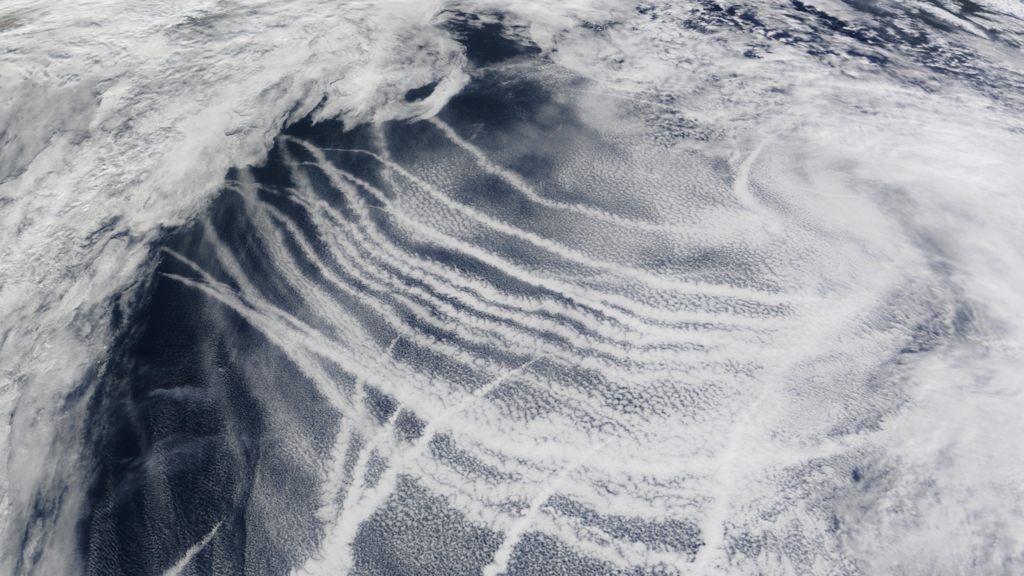
 Image: NASA's Goddard Space Flight Center
Sulfur aerosol in ship exhaust seeded brighter marine clouds, reflecting heat. In 2020, clean-air regulations removed that aerosol, inadvertently resulting in a measurable increase in the rate of global ocean warming. The clouds dimmed. The planet got warmer.
Nephele puts the reflectivity back in ship emissions. Deliberately, cleanly, with pure seawater.
Pre-2020 ship tracks over the Pacific. White trails of clouds reflected solar radiation, unintentionally cooling the planet and staving off global warming. This is what we've lost.
Every marine cloud brightening proposal has struggled with spiraling complexity. We're proposing the brute-force method: inject seawater spray into cargo ship exhaust, hijacking existing emissions scrubber architecture. A mist eliminator passes only CCN-active droplets into the warm, saturated plume. The droplets stay liquid the entire way to cloud base. No drying, no reactivation needed.
No new science. No purpose-built fleet. No precision nanoparticle engineering. Just off-the-shelf hardware piggybacking on scrubber hardware that already exists on over 4,000 active industrial vessels.
Nozzles spray filtered seawater onto a rotating splash atomizer below a mist eliminator, downstream of the scrubber. The mist eliminator passes only sub-micron droplets into the plume. Tap into existing scrubber seawater plumbing, using less than 1% of its water throughput.
The warm, saturated post-scrubber exhaust carries solution droplets upward. They never dry, and remain pre-activated as cloud condensation nuclei. Thermal buoyancy delivers them to cloud base in minutes.
Solution droplets activate as cloud condensation nuclei at very low supersaturations, with no deliquescence barrier to overcome. Droplet number and reflectivity increase via the Twomey effect. Onboard monitoring and satellite verification attributes reflected heat to individual vessels.
CERES/MODIS radiative forcing data verifies the cooling. We compensate participating vessels, reducing their emissions compliance costs.
Stop injection, and the effect ceases within hours. No persistent atmospheric modification, no long-term commitment. We are seeking to operate under full IMO MEPC oversight. Cloud brightening should be tightly regulated, transparently verified, and institutionally governed.
We are restoring an effect that shipping itself produced for over a century, backed by research that has been well-understood for decades.
Seawater aerosol atmospheric lifetime is hours to days. Cessation of injection immediately halts the effect - the strongest possible off switch.
NaCl replaces SO₂. Chemically inert in the atmosphere, naturally present in the ocean, and far more controllable. Unlike sulfur, what we inject is exactly what arrives at cloud base. No uncontrolled side reactions.
Simple hardware, proven materials, installed during a routine port call.
Scrubber-equipped industrial vessels already have the plumbing and exhaust infrastructure to implement immediately - the fastest possible route to global cooling.
NASA's CERES instruments provide independent, auditable radiative forcing measurement. Every watt is accounted for.
Our whitepaper details the physics, engineering, verification methodology, regulatory pathway through the IMO Net-Zero Framework, and revenue model for ship-integrated marine cloud brightening.
Whether you're a shipowner, regulator, researcher, or investor, we'd like to hear from you.
info@nephele.earth